JOURNAL
"Unlearn to Begin Learning"
An intimate report of making art and living at the Amazon Rainforest
by the filmmaker and researcher Lara Jacoski
"As a filmmaker, I am a good anthropologist. As an anthropologist, a good philosopher. As a philosopher, I am a poet. As a poet, an eternal student."
Reflecting on my 16 years of creating documentary films with traditional and indigenous communities in Brazil, throughout Latin America, and globally, I've arrived at the thought mentioned above. I am not a filmmaker; I opt to fully embrace my existence, not limiting myself to a conventional role, but as a lifelong learner. Therefore, no potential title could reflect my essence, and the decision to forgo a label enables me to engage differently with the medium I selected —in this instance, filmmaking and capturing various worlds with closeness and respect. This is an article that dive into my experience as a Brazilian filmmaker and a present human being.
It was the journey of eight years dive into the Amazon Rainforest, with “Eskawata Kayawai: The Spirit of Transformation” project, that has somehow allowed myself to be, and express this mindset above. This project is a feature documentary created about and in partnership, in relationship and in kinship, with the Huni Kuin indigenous people.
From the idea, to its development and producing it, numerous lessons and changes took place - be it in the doing, and in the being. The editing phase, in particular, provided significant insights. As it was the pandemic time, everything stoped and somehow, I could create a more immersive stage experience. I've immersed myself in a forest setting for the whole pandemic, and beyond that time as I continued to live in rural areas after that. I believe this surrounding allowed be to put in practice what I was continuously learning, while I was watching the interviews multiple times, exploring the material and gaining many insights. Plus, I was practicing by bathing in the river, planting my food, or enjoying contemplation on nature. I believe by choosing this setting, I wasn't merely narrating this beautiful tale about people's lives and a wonderful experience I once lived: I was honoring it, by also exploring this wisdom by myself, experiencing in my own body, embodying some of their culture and teachings.
The movie ended up being very well accepted globally, and I had the opportunity on sharing some of my personal experiences, together with the indigenous people narratives. I've realized I could serve as a bridge, not just by producing the movie but with my living experience. I could share how I got in the Amazon rainforest, how did I experienced the indigenous village and community , and what I've become. That's where I would like to take you now.
I believe numerous lessons emerge where our focus is ,really, be it living everyday life or at projects. When a person welcomes the opportunity to observe, listen and reflect before taking action, the learning process takes place. We are lifelong learners, and that's who we are during our lives—or at the very least, we ought to remain open to that possibility.
Before the journey into the mysteries of the Amazon Rainforest, I'd like to start saying the world is full of diverse perspectives and ways of living. All of them support us to puzzle together this immense world of so many particularities. I truly believe, when one has the opportunity to interact with a different culture, in diversity, instead of comparing, is time to observe and learn. With that, I believe we must be attentive on how to find a point where we can meet somewhere in the middle. That gets even more particular when relating to, and producing work together with, indigenous and traditional communities. And to work, first there is something else that precedes: to create relationship, where a genuine connection can only happen through presence, that means observation, which allows a true connection to happen - the meeting point. So, if I want to make a film project capturing the seen and unseen through images and sounds, I must deliberately observe, listen, and honor. A position to learn is key, together with a commitment to integrity.
I understand that, to build relationship specially with indigenous and traditional peoples, there should be requirement on unlearning - an invaluable tool for this century. We have normalized so much that doesn't really dialogues to the natural law/order, that we can't really take much for granted. There is a strong need to take a closer look into decolonial perspectives, which means, there is a need on assisting in breaking down the perception of the world as "unchanging", and particularly, on "life as a product". Contemplation is key here. Allow enough space to go beyond "being productive" so we can truly see what is present in space, who is in front of you, what are this people's needs and so on.
“Deep listening is an opportunity for self-knowledge. It's our ability not only to hear the words of another but also to embrace and honor them, accepting and letting go of our internal expectations and judgments"
- says the Brazilian contemporary thinker Lua Couto.
A little bit where I come from and I promise we will take a deep dive. To film is an extension to live and produce art on what I am interested on learning and keep growing. In 2013 I have established and managed the BTV independent film production with a focus to produce documentaries with total creative allowance, from writing the script to distributing the final product. I managed (meaning, the mystery has allowed me) to navigate into various worlds, providing the audiovisual as resource to enhance voices of beautiful people around the world. In this way I’ve come to understand that all work is a form of service, and every service prompts internal transformation. Therefore, cinema has never been the destination but a vehicle through which I explored what stirs and moves within me, fostering the harmony between my inner and outer realities, the personal and the communal.
Making a long story short, I ended up reaching the Amazon Rainforest as one of the paths of this inner commitment. A eight years commitment unfolded unexpectedly, and among that, a film manifested. “Eskawata Kayawai – The Spirit of Transformation” is a documentary focused on the cultural and spiritual resurgence of the Huni Kuin people's identity within the Humaitá indigenous territory, with its seven villages. A project created from the art of connection, cultivated through deep listening, and commitment to seek to go beyond personal interpretations and desires, the project was born in concordance of the communities needs and wishes, with their own story and narratives.
To reach the village I had to endure several hours of flights with three flight connections, followed by seven hours in a taxi, spending a few days in a small city arranging all the food and production. Ultimately, to get into the boat to be transported for four days upstream, reaching the very last village.
In the beginning, it’s difficult to comprehend that I was in the Amazon rainforest. What we observe in the first two days of boat it is only farmland and livestock. (Leading to the thought about the effects on how Brazilians consume meat everyday in Brazil, that farmlands has to settle into distant lands). Ultimately, once the Indigenous Territory is marked "You are entering an indigenous land", EVERYTHING changes. It’s as if a boundary is crossed, telling a story on how different people relate to the same environment, and how they see nature. On one hand, we see the avarice of individuals who interact with the land through resource exploitation, and on the other, the conservation that practiced in everyday living together with the forest by those who live in harmony, through connection and cooperation with the land.
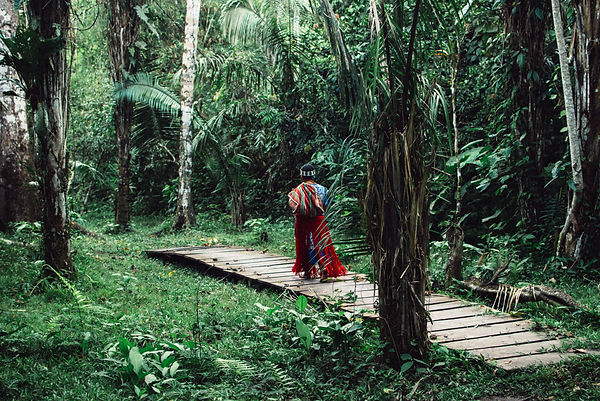
We enter a space of an enormous forest, gigantic trees create a vast woodland, a rich green tapestry inhabited by numerous hues and species, providing access to a different ambiance. The further I journeyed into the core of the Amazon rainforest, the stronger the sensation I was delving into my own heart.
During the boat days, I concentrated on seeking silence, making an effort to release what wasn’t beneficial for me, the community, or the film production I was producing. I was cautious, seeing myself as a daughter of era of poli crisis (specially of perception and awareness) that was developed by western mindset. For days I meditated on being careful not to reach the village without seeking consent, or by holding a predetermined idea in my mind which could make me unable to connect with the collective reality, due to attachment to personal beliefs. Lot's to think about. I've realized how nowadays society tend to unwittingly perpetuates colonial notions disguised as normalcy, prioritizing self-interest while emerging from a culture that thrives on the illusion of separation and has limited insights into interdependence and interconnectedness. Albert Einstein remarks on the distorted perception of reality, stating:
“One experiences himself, thoughts and feelings, as something separate from the rest, a sort of optical illusion of his consciousness. This illusion is a sort of prison for us, restricting us to our personal desires and affecting some of the people closest to us. Our task must be to free ourselves from this prison by widening our circle of compassion to embrace all living creatures and all of nature”.
Upon my initial arrival at the village, I had a fever. My entire body ached and twisted. I think it was the liberation of so much thought and realization I had in the boat. All that, together with the effect on my body, by never had feeling so much vitality surrounding me. Life codes were penetrating and refreshing my whole being through the pores of my skin. The vibration was extremely powerful. My body was shaking, and aching. I was greeted by these friendly teachings regarding my insignificance in front of this vast forest and the timeless knowledge that the indigenous peoples protect with their lives, bodies, and souls.
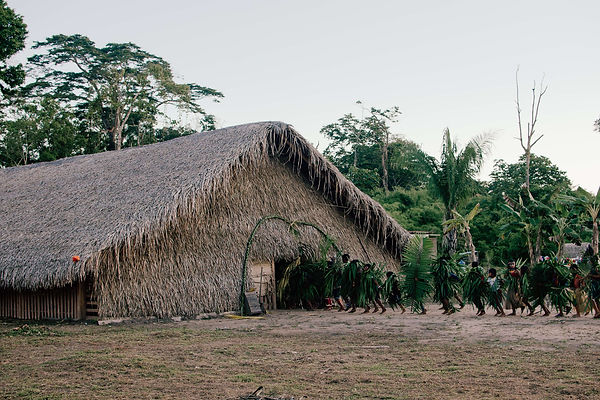
The news that I have arrived in the village shaking in fever had been delivered to a pajé/shaman, that soon approached to assist me. He observed me and quickly suggested that I join the evening ceremony where they would offer ayahuasca - an ancient new made by chacruna leaves and jagube vine, in fact an ancient living entity and guide of life and death that has led many generations. Despite having a high fever and chills, I trusted the old man. I rose up and walked to the maloca – the communal prayer house. Just a few hours went by when I've joined the ceremony, I suddenly noticed, I was dancing, entirely overlooking the illness I felt when the ritual started. The order was presence and trust.
“Being in relation to life itself, in the face of the deepest imperatives of being and existence – the aspirations that escape the dominion of worldly things. True living is beyond all determinations.”
Albert Schweitzer in his book The Decline and Regeneration of Culture.
The days progressed organically, to be present was the core of life in the village, and for the whole living and producing with the Huni Kuin people. We spent the next three years going to Humaitá Indigenous Land, and the relationship and the project had come to be by itself, unfolding very naturally. We ended up making thirty unplanned interviews with community members and leaders from multiple villages, in different indigenous territories. As the years passed by taking so many interviews, the central subject had presented itself. The community have opted to approach the narrative of their cultural resurgence, as that was what they were living. We subsequently started to make a feature film about it. The spiritual leader of the Novo Futuro village, Ninawá Pai da Mata, consented and became a co-producer. After that, internal gatherings were arranged in the village and across the indigenous area to present the concept and gather opinions on the initiative.
We needed time to delve, it was only in our third visit that something emerged, gradually, as we began to unlearn. I recall about the mental-planning-control being challenged. There was a specific happening that led me to a learning process — which I'd like to call it as teacher-situation.
Every year we hade attempted to arrange at least one to three important interviews, the remaining interviews were very spontaneous. We wanted to film Yube Tete Pawã, as he was and is a young leader, and son of the film's central figure, Ninawá leader Pai da Mata. A young leader and skilled apprentice in spirituality and the arts, who from a young age, has displayed a very strong presence, presenting himself as a natural born leader.
Whenever we arranged an interview with him, an unforeseen event occurred that kept us from doing it, years after year. On one occasion, we were able to arrange an interview for 3 PM. But of course, he never came. I've realized that 3pm, time, isn't an actual shared reality in their community, that was not how the community connected with space and between themselves. Maybe if we had proposed something associated with the sunrise or the rain around lunchtime, it would have been considerably simpler. It was only in the third year, with just two days remaining before departing to travel to the next villages, something occurred. The story I am about to tell, it starts with a day before that, when I've truly believed that I have made all I could do to this movie happen, taking good care of all details, therefore considered the work finished. It was when I could finally relax to enjoy the last two days, releasing all mental planning, when everything really happened.
I rose at 4:30 AM to the sound of birds, which I found in the village to be my favorite aspect of the day, I probably have never woke up so early. Actually, all my life I believed was a more night-person to a more day-person. Before even opening my eyes I could already hear a few community members approaching to gather and rake the soil floor of the terreiro - the open-air communal space where people come together during the day for several activities and gathering.
The melody of the birds was so lovely that it urged me to step outside my hammock for the day. I stepped out of my hut and encountered thick fog, the surroundings were all blue. It was beautiful. I greeted the women and children raking and chatting. As I stood there watching closely one of the final days in the village, I was somehow keeping that moment in my memory with my gaze. Yet I couldn't help but keep appreciating the melody of the birds. I have always been quite moved by birds. I couldn't not do it - I went back to the hut and picked up my audio recording gear. I began to walk very slowly through the village, guided by the birds greeting the day.
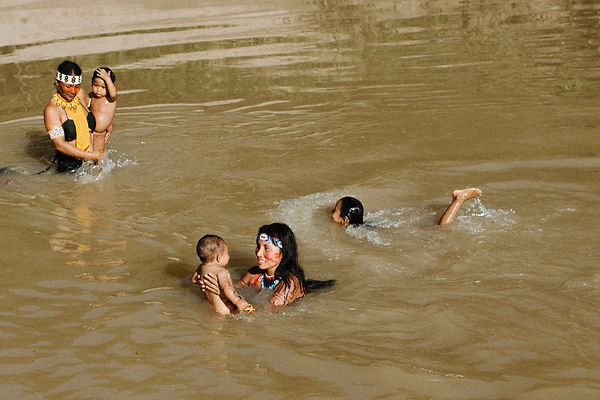
I walked, contemplating and observing the details, sensing the forest awaken, valuing the morning moisture and the sun shining through spider webs. At a certain moment, I decided to activate the sound recorder, placing it somewhere. I kept walking and went through abandoned areas to thick forests, while also stopping by to see relatives who were waking up and coming back from their baths. A quick comment regarding that: I also have realized that Brazilians generally value cleanliness due to our indigenous heritage. In indigenous communities, for a day to begin or conclude, it has to be accompanied by a proper bath, and that was the base of how the Ministry of Health was settled in Brazil.
I enjoyed the first morning with several villagers until the sun started to shine in full force. The day was very sunny, and I had a feeling something unusual was in the atmosphere. For sure, I was different - I wanted nothing. I chose to return to my hut, as I began to remove the extra layers due to the cold morning. While walking, I picked up my audio recorder on the way, and as I got closer to the terreiro, I saw some motion. The children were joyfully playing. I quickly spotted Patrick Belem, co-director of Eskawata Kayawai, alongside Lucia Alonso, responsible for the camera and still photography for the third year of the film. They also awoke in inspiration and decided to fly the drone to give the video as a gift to the community. Images as to reveal the village throughout a bird eye — images that later became crucial for the film's start. The kids were noisy and playing, eagerly chasing the drone and then hiding, as usual, creating their own games.
The day was bright, a call to experience life. Motivated, I picked up my camera and took another stroll. The forest called me, revealing itself, it felt like the forest was directing my path and where to point the camera. I have recorded continuously until the sunlight became too intense to proceed and the and the battery had already run low, my camera overheated. I went to the hut andl met Patrick and Lucia there. While we were receiving many visitors (we had kids almost 24 h in our hut, curious with us and everything about us), the batteries were recharged.
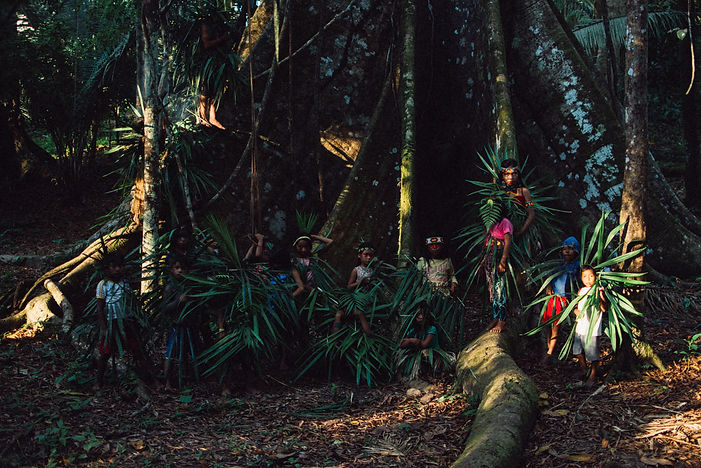
Unexpectedly, Yube showed up at the hut's entrance, the son of Ninawá Pai da Mata! He just leaned into the hut and remarked, “now, txai” - txai is a term used to refer to a friend, a brother, a relative, among the Huni Kuin and native Pano speakers. That was the signal, the moment had arrived, it was time. After three years, the chance simply arose out of the blue in our own hut. The law of less effort. We swiftly collected our gear and trailed behind him through the forest. He strode forward, resolute, aware of his destination, clothing a beautiful blue poncho, holding his guitar and walking forward without looking behind. We walked behind him, into the forest's core, where we met the enormous Samauma tree, home to the spirits and the waters. The Samauma is the biggest tree in the Amazon Rainforest, and among the largest globally, it can grow up to 60 meters tall and 40 meters across its crown, with a trunk measuring up to 3 meters in diameter – it's not surprising that some refer to it as the tree of life. He settled himself at the base of the massive tree and said, “What would you like to ask, txai?”.
We flowed along, and, with each passing moment the conversation evolved. We knew the film was transforming with the presence of the youth leadership. Yube is a representative of his generation, a generation that has already had the opportunity to be born and live within its own culture and identity. Very different from the past generations, forbidden to own land, language, plant medicines, their own food and clothes, not even mentioning their rituals. He was the very portrait of the revival itself.
We stayed in the forest for quite some time, as after we interviewed him, Yube immediately picked up his guitar and delivered a good 40min of his own music. It was time for him to present, besides language of mental cognition, now in melody and vibration. We have received the blessings of someone who had recently begun his first spiritual journey and overflowed with strength, confidence, and hope. He is the personification and victory of the strong mission his father undertook, to achieve for his entire village, community, and people: to conquer their identity back.
After the magic, the day didn't end up there. It was a series of unfolding events, including several important exchanges, documenting various interviews that has guided the film, beautiful sound, music, and images that capture the enchantment of the forest. I've filmed from 4:30 AM until 4:30 AM of the following day, most likely representing 40% of the material that makes up the finished film. It was a magical happening: accomplishment aligned with permissiveness. The teaching was, when one stop producing this vibration of "wanting", which generates tension between you and what you want, when you truly have the ability to surrender control of what you believe you need, desire, and seek, then and only then space is created for another vibration to begin to pulsate. And within this new vibration, we can find availability to find what is really there, and what is there can finally find you, creating true dialogue. When we stop seeing our own world and open ourselves to seeing what exists, manifestation takes place.
This experience marked me, it was a profound lesson for my life and work. I believe this happening supported to engaje to life by observing the whole picture first, beyond my interests. By seeing more clearly I could engage with what was there, an opening or a closing, an invitation or a blockage, or simply an indication to change the course. For that learning to happen, some unlearning on how to be in this world has to decay. The normalization on how to be in this world.
I give an example of that in an extreme situation. I've unfortunately encountered more than once, other filmmakers at indigenous lands working in a very colonial way. People go to the village with limited time, with an idea in their head, requiring things from people with a voracious desire to accomplish their ideas, even entering into power games of false promises to acquire what they are there to take. The last time I witnessed this, I was shocked to see how beautiful cinematic videos for social media was being produced.
It was their first time at the village, and probably within the Huni Kuin lands. They had three days to film and were to start the very next day after their arrival. There was no time to build relationship, with land and people. There was no participation in daily life or cultural events to properly meet their culture. The had walked through the village only to assess the "locations", with a mercantilist perspective, looking at land and culture in a way to extract images. They continually mixed people's names, they dared to say how people should make their hair or paint their sacred geometries. There was neither time nor space to get to know the people, their families, their homes, their clans, their worldview, their wisdom...
To fulfill their pre-established objectives, they have disrespected the community. But probably till this day, they haven't even realized it. That creates harm, specially because it teaches the indigenous peoples: if they were to be heard they have to conform themselves into disrespectful ways of working and sharing wisdom.
“The pilgrim undergoes a change in consciousness, and for the pilgrim this change is real. Pilgrimage is a form of initiation, and initiation is an opening to other forms of cognition (...) the pilgrim – we can say – leaves the “secular space” of home and travels to the “sacred space” of the sanctuary to experience the difference between “secular” and “sacred.” Hakim Bey
I quote this historian and poet, after my storytelling, to shed light on a very important perception on what kind of culture we want to perpetuate with our interactions, our relationships. Working with art, especially, there is a need to go far beyond the mastery of the technique. To produce, only, is not something to be proud of, but on how to engage. To research and seek to understand the fundamentals of how and why one is proposing this art work.
Art has always reflected on how humanity is perceiving the world, it reveals one's own essence and nature. Art is moved by the force that moves existence. At this time of a needed decolonial thought, we better imbue creation with our spirit, and not just with the capital mind. As Fabio Rubio Sacarano says, "the degradation of the biosphere and the distancing between the human and the natural imposes the apocalypse of time (...) The past of our individual history tries to anchor us in the present of our values, which is bombarded by the future that is already almost yesterday." We are better than that, and we can support this transformation to rise.
Through all this journey I've learned that, rationalized thought solely driven by the mind, without integrating the whole being, is dangerous. We need to free ourselves from the fragmented places into which society insists on confining us. We need the mind, but also the body who indicates, the feeling who evaluates, the intuition who reveals. We need ourselves as a whole to relate, a condition of existence. Relating to others, is how we live and how we test ourselves. An individual world is formed in the thought, confirmed in our dialogue, transformed into action, nourishing (or not) certain paradigms and worldviews.
Indigenous peoples and traditional communities are guardians of a cosmology that we need to relearn, re-access, and remember, in order to move forward. Not that they are to be in a pedestal, no one should be - they are humans, like us. But humans that still remember. I feel blessed to have the opportunity to be so close to these communities, learning and sharing wisdom.
This is my life, my sharing, my tale. I’ve learned that to bear fruit from ancestral knowledge and the natural order, to be connected to the land and a cosmovision, it is necessary to be willing to learn to unlearn. It is necessary to be willing to set oneself aside a little, to finally find oneself, and overcome the limitations that prevent listening to, and understanding natural wisdom beyond the colonial codes in which we are embedded. The belief of the need to fit, to place humans above the nature, our own nature, led us to become narrow-minded machines. This way of living prevents us from living really, it hardens our hearts, and feed the individualistic logic rooted in fear, and the imaginary of separation. Even so, if we keep away that 'something is missing,' our spirit might manage to forge a path... maybe to the heart of the Amazon rainforest. But still, there is a big challenge. It is no use carrying and sustaining the logic of the city with us into the middle of the forest.
If one knows on how to ask for permission and respect those who came before, one is allowed to move forward. To arrive calmly, to want nothing, to know how to be silent and observe where one steps, to respect to learn no how to learn. Only then can we re-establish a true connection with the ground we walk on, to the people we relate, to the nature we are in the nature we exist. These 10+ years of learning alongside indigenous and traditional peoples teached me to navigate life through the invitation to self-knowledge, to dive a little deeper. Ten years, yet still in the beginning of this long journey of unlearning to learn, on how to live. I close with the great indigenous philosopher Ailton Krenak, “to postpone the end of the world we have to tell one more story (...) during the story told or heard, eternity is prolonged: a time capsule in which hope sails, which propels us forward.” Here is my story, of my stories, which are the stories of the intersection of many lives.
*All photographs by Lucia Alonso @lucithehuman
Eskawata Kayawai” @eskawatafilm - Watch the documentary mentioned here:
https://watch.eventive.org/eskawatafilm/




.jpg)

.jpg)